


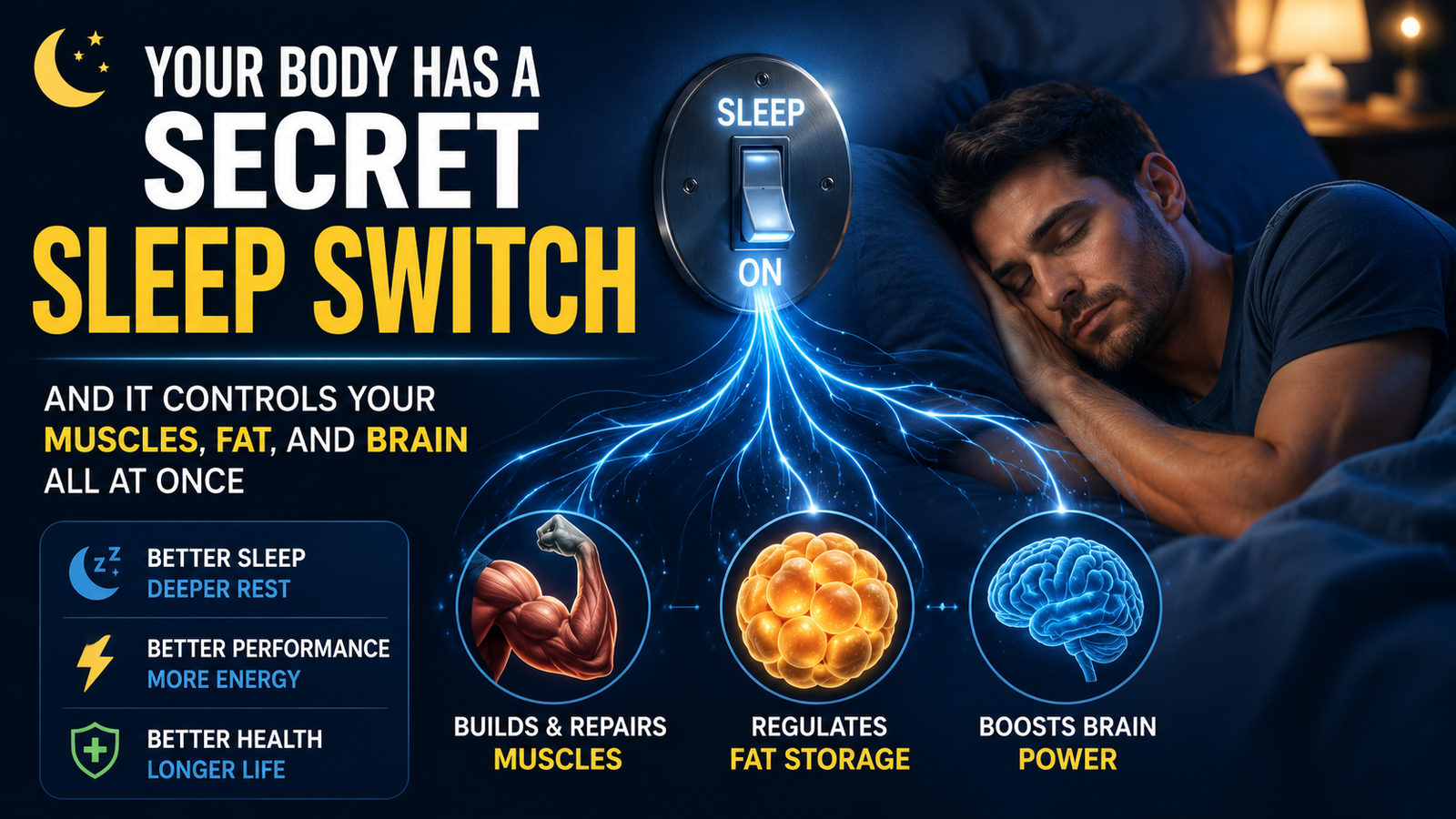
You already know sleep is important. You have heard it a thousand times. But here is what nobody told you: deep sleep is not just rest. It is the single most powerful hormonal event your body runs every single night. And a landmark study from UC Berkeley published in March 2026 just proved exactly how that works at the brain circuit level.
Researchers found a previously unknown feedback system inside your brain that links deep sleep directly to growth hormone release. That growth hormone then controls whether you build muscle or lose it, whether you burn fat or store it, and whether your brain stays sharp or slowly fogs over. All three. At once.
This is not a minor finding. This is the kind of research that changes how doctors think about sleep, metabolism, and hormonal health. And if you are a man over 30 who has been struggling with low energy, stubborn body fat, or feeling mentally off, this article is going to be worth your time.
What Scientists Actually Found
The UC Berkeley team mapped the specific brain circuits inside the hypothalamus that govern how your body releases growth hormone during sleep. The hypothalamus is a small but incredibly powerful region of the brain that controls things like hunger, body temperature, and hormone output.
Inside it, researchers identified two groups of nerve cells that work together in a push-pull system. One group sends signals to increase growth hormone. The other dials it back down. The balance between those two groups determines how much growth hormone gets released during any given night of sleep.
Here is the critical part: this balance shifts depending on what stage of sleep you are in. During deep sleep, specifically the slow wave stage that most adults do not get nearly enough of, the system tips heavily toward hormone release. During lighter sleep stages it pulls back.
The study also uncovered something nobody had properly mapped before. Growth hormone does not just get released passively during sleep. It actively feeds back into the brain and helps regulate wakefulness itself. Sleep drives hormone release. Hormone release helps regulate sleep. It is a loop, and when it gets disrupted, the whole system starts to break down.
That breakdown shows up as poor body composition, persistent fatigue, brain fog, and metabolic problems. Sound familiar?
Why This Matters More Than You Think
Most men over 30 have heard of testosterone. Fewer think much about growth hormone. That is a mistake.
Growth hormone does not stop being important after your teenage years. It continues to play an essential role throughout adult life. It helps preserve muscle tissue, signals your body to break down fat for fuel, supports bone density, and plays a direct role in cognitive function and mood regulation.
After your mid-twenties, growth hormone levels naturally start to decline. That decline is gradual but consistent. By the time most men are in their 40s, their nighttime growth hormone pulses are significantly weaker than they were a decade earlier.
Poor sleep accelerates this dramatically. Even a few nights of disrupted sleep is enough to measurably reduce the growth hormone your body produces overnight. And because of the feedback loop this study identified, less hormone means worse sleep quality the next night. Worse sleep means even less hormone the night after that.
This is why so many men describe a slow but relentless decline in how they feel physically. It is not just age. It is the sleep and hormone cycle quietly breaking down over months and years.
The Three Things Suffering When Your Sleep Switch Is Broken
1. Your Muscles
Testosterone gets most of the attention when it comes to muscle mass in men. But growth hormone is equally important, especially for muscle repair and recovery.
When you train, you create tiny tears in muscle fibers. Growth hormone released during deep sleep is what signals those fibers to repair and rebuild stronger. Without adequate deep sleep, that repair process is incomplete. You could be lifting consistently and eating enough protein and still losing ground because the hormonal environment overnight is not supporting recovery.
Men who report that their workouts have stopped producing results, that recovery takes longer than it used to, or that their strength seems to be sliding despite consistent effort are often dealing with exactly this problem.
If you are already dealing with the strength and muscle side of this, it is worth reading our guide on How to Build Stamina Fast alongside improving your sleep. The two work together.
2. Your Body Fat
Here is something counterintuitive that most people do not know. Growth hormone is one of your body’s primary fat-burning signals. It tells fat cells, particularly the visceral fat stored around your abdomen and organs, to release their stored energy as fuel.
When growth hormone is suppressed, that signal weakens. Fat cells hold onto their stores. Your metabolism slows. The same caloric intake that once maintained your weight now leads to gradual fat accumulation.
This is a major reason why men in their 30s and 40s often describe gaining fat without eating more or exercising less. Their diet has not changed. Their activity level has not changed. But their hormonal environment has shifted in a direction that strongly favors fat storage over fat burning.
The belly fat in particular is dangerous. Visceral fat drives inflammation, increases cardiovascular risk, and critically, converts testosterone into oestrogen through an enzyme called aromatase. More belly fat means lower testosterone. Lower testosterone means even more fat accumulation. Poor sleep accelerates both sides of that equation.
If weight management has become a challenge and you have already tried the lifestyle approach, you might want to look into what medical support options exist. Our guide on Is Ozempic Right for You walks through what GLP-1 medications are, who they are appropriate for, and what questions to ask your doctor before considering that route.
3. Your Brain
The cognitive effects of poor sleep are well documented. But what this study adds is a specific mechanism: growth hormone released during sleep is directly involved in the brain processes that regulate mood, focus, memory consolidation, and wakefulness the next day.
When you sleep poorly and growth hormone release is suppressed, you are not just tired the next morning. The hormonal feedback loop means your brain received fewer of the overnight signals it relies on to reset. Over time this contributes to persistent brain fog, reduced concentration, emotional blunting, and that general feeling of being mentally slower than you used to be.
Many men attribute this to stress or just getting older. Sometimes it is. But a significant number of men experiencing these symptoms have an underlying sleep quality issue that is directly suppressing the hormonal signals their brain needs to function at its best.
What Disrupts Your Sleep Switch
Understanding what damages this system is just as important as understanding how it works. Several common factors directly impair deep sleep and therefore growth hormone release.
Alcohol is one of the most significant. Many men use alcohol to fall asleep faster, not realizing that while it does initially promote drowsiness, it severely fragments sleep architecture in the second half of the night and almost completely eliminates restorative slow-wave sleep. The very sleep stage that drives growth hormone release.
Chronic stress keeps cortisol elevated. Cortisol is the wakefulness hormone. Elevated cortisol at night directly interferes with deep sleep and suppresses the growth hormone response. Men under prolonged stress often report sleeping long hours but waking unrefreshed. This is why. Sleep duration is not the same as sleep quality.
Blue light exposure from phones and screens in the two hours before bed suppresses melatonin and delays the transition into deep sleep. You fall asleep but your brain enters the deep stages later and spends less time there.
Sleep apnea is one of the most underdiagnosed conditions in men over 35. Each time breathing pauses during the night, your body jolts itself partially awake. These micro-arousals fragment sleep architecture completely. Men with untreated sleep apnea essentially never get meaningful deep sleep. If you snore heavily, wake with headaches, or feel exhausted regardless of how long you sleep, ask your doctor about a sleep study.
Late eating raises insulin and body temperature at a time when both should be declining for deep sleep to occur. Eating within two hours of bed consistently reduces slow-wave sleep duration.
How to Actually Improve Your Deep Sleep
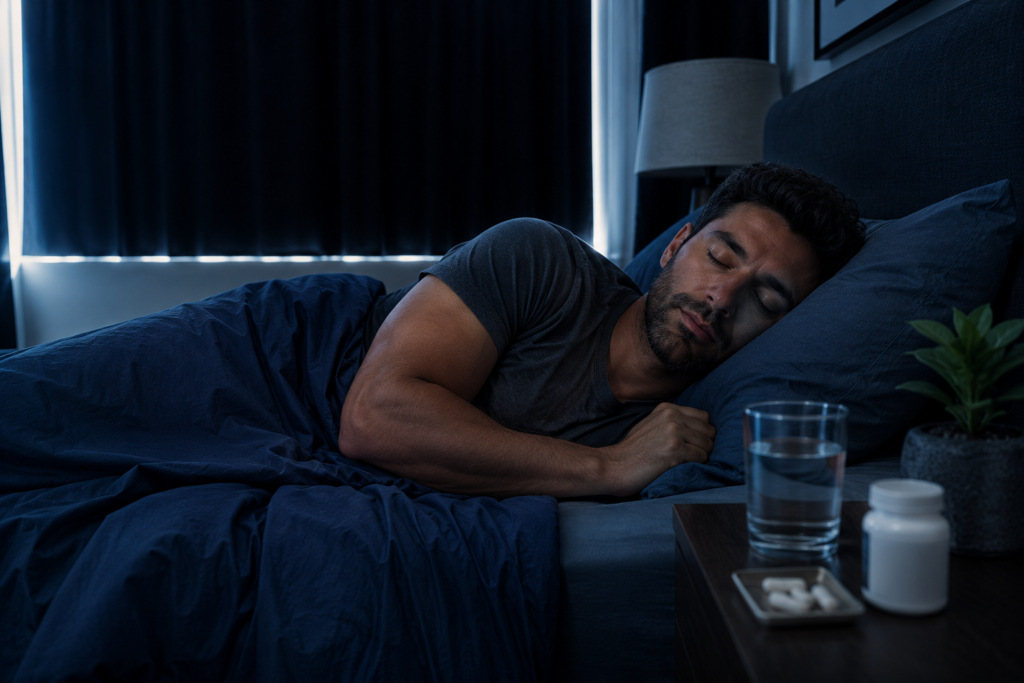
The research from UC Berkeley makes one thing very clear. You cannot supplement your way out of poor sleep quality. No testosterone booster or hormone supplement addresses the root cause of disrupted growth hormone release if your deep sleep architecture is broken. The fix starts with sleep itself.
These are the strategies with the strongest evidence for improving slow-wave sleep specifically.
Maintain a consistent sleep schedule. Your brain’s sleep drive is governed by circadian rhythm. Going to bed and waking at consistent times including weekends is the single most effective thing you can do for sleep quality. Irregular sleep schedules fragment deep sleep even when total duration is adequate.
Keep your bedroom cold. Core body temperature needs to drop for deep sleep to occur. The ideal bedroom temperature for slow-wave sleep is between 60 and 67 degrees Fahrenheit. Most people sleep too warm.
Eliminate alcohol. Even one or two drinks measurably reduces slow-wave sleep duration. If sleep quality is a problem you want to solve, alcohol is the first thing to address.
Get morning sunlight. Natural light in the morning anchors your circadian rhythm and ensures that your sleep pressure builds appropriately throughout the day, leading to deeper sleep at night.
Cut screens two hours before bed. This is not new advice but it works. If you cannot eliminate screens entirely, blue light blocking glasses are a reasonable compromise.
Magnesium glycinate before bed. Among supplements, magnesium glycinate has the most consistent evidence for improving sleep quality, specifically slow wave sleep depth. Most men are deficient. A 300 to 400mg dose taken 30 to 60 minutes before bed is the typical starting point. Unlike sleep medications, magnesium does not suppress deep sleep. It supports it.
Sleep and Testosterone Are More Connected Than You Realize
If you are reading this on Greenifyer, you have probably already encountered our content on testosterone. What this new research makes clearer than ever is that sleep and testosterone are deeply interconnected.
Studies have shown that men who sleep fewer than six hours per night have testosterone levels significantly lower than men sleeping seven to nine hours. The mechanisms are multiple. Poor sleep raises cortisol, which directly suppresses testosterone production. It reduces growth hormone, which works alongside testosterone to maintain muscle and metabolic health. And it impairs Leydig cell function in the testes, the cells responsible for testosterone synthesis.
If you have been experiencing symptoms of low testosterone including persistent fatigue, reduced libido, difficulty building or maintaining muscle, or mood changes, and you have not yet looked seriously at your sleep quality, that is the place to start. Our Low Testosterone Symptoms in Men Over 30 Complete Guide covers this connection in detail and explains when to get tested.
A Note on Supplements and Sleep Support
A lot of men reach for sleep supplements hoping to improve their overnight recovery. Some work better than others. Here is a quick overview based on current evidence.
Magnesium glycinate: strongest evidence for improving slow-wave sleep depth. Well tolerated. Not habit forming.
Ashwagandha: adaptogen that reduces cortisol over time. Studies show meaningful improvements in sleep quality and morning energy with consistent use over 8 to 12 weeks. Not a fast fix but effective with patience.
L theanine: amino acid found in green tea. Promotes relaxed alertness without sedation. Often combined with magnesium for a mild synergistic effect. Particularly useful for men whose sleep problems are driven by racing thoughts rather than circadian disruption.
Melatonin: widely misunderstood. Works best for resetting sleep timing, like overcoming jet lag or shift work. Not particularly effective for improving deep sleep quality in men with non-circadian sleep problems. Most men take far too high a dose. 0.5mg is often more effective than 5mg for sleep quality improvement.
Avoid sedating antihistamines like diphenhydramine found in many over-the-counter sleep aids. They make you drowsy but actively suppress slow-wave sleep. Exactly the stage you need most.
When to Talk to a Doctor
Lifestyle changes are powerful. But they are not always enough, and some sleep problems require medical evaluation.
Talk to your doctor if you snore loudly or your partner has noticed that you stop breathing during sleep. This is sleep apnea until proven otherwise and it requires proper diagnosis and treatment.
Talk to your doctor if you have made consistent sleep hygiene changes for six to eight weeks with no meaningful improvement. Underlying hormonal issues, thyroid dysfunction, or mood disorders can interfere with sleep in ways that lifestyle alone cannot fix.
Talk to your doctor if your symptoms include severe fatigue, significant mood changes, or notable physical changes like unexplained weight gain or muscle loss alongside poor sleep. A full hormonal panel including testosterone, thyroid, cortisol, and vitamin D gives a much clearer picture of what is actually happening.
The Bottom Line
A 2026 study from UC Berkeley confirmed something that should change how every man thinks about sleep. Your brain contains a specific hormonal feedback system that is activated during deep sleep. When it works properly, it releases growth hormone that builds muscle, burns fat, and keeps your brain sharp. When it does not work, all three of those systems suffer.
Poor sleep is not just tiredness. It is a nightly disruption to the hormonal machinery that keeps your body and brain functioning at their best.
The good news is that this system is not permanently broken. Sleep quality is one of the most responsive things to targeted lifestyle changes. Temperature, alcohol, light exposure, stress, meal timing, and supplement support all have measurable effects on deep sleep architecture. Start with one change this week and build from there.
Your body is ready to fix itself. You just have to give it the conditions it needs to do that work.
FAQs
Q: What exactly is the sleep switch that scientists discovered?
Researchers at UC Berkeley identified a set of nerve cells in the hypothalamus that form a feedback loop between deep sleep and growth hormone release. During slow-wave sleep these cells tip toward hormone release. The growth hormone produced then feeds back into the brain and helps regulate wakefulness. When sleep is disrupted, this loop breaks down, reducing growth hormone output and impairing the body’s ability to maintain muscle mass, burn fat efficiently, and support brain function.
Q: How much deep sleep does a man actually need?
Most adults need between 90 and 120 minutes of slow-wave sleep per night, which typically makes up about 15 to 20 percent of total sleep time. So for a man getting 8 hours of sleep, roughly 72 to 96 minutes should ideally be deep sleep. Many men, especially those over 35, get significantly less than this due to stress, alcohol use, sleep apnea, and poor sleep hygiene.
Q: Can low growth hormone levels in adults be treated?
Adult growth hormone deficiency is a real medical diagnosis that can be treated, though it requires proper testing and is not prescribed lightly. The more accessible approach for most men is optimizing sleep quality, which directly supports natural growth hormone production, alongside lifestyle factors like resistance training, stress reduction, and dietary improvements. Speak with an endocrinologist if you suspect significant hormonal deficiency.
Q: Does this mean testosterone boosters are less important than sleep?
Not exactly. Testosterone and growth hormone work together rather than competing. But the research does reinforce that no supplement can compensate for consistently poor sleep. If your sleep is broken, your hormonal environment is broken. Addressing sleep quality first gives any other interventions including testosterone optimization a much better chance of working. Think of sleep as the foundation and everything else as the structure built on top of it.
Q: How quickly can sleep quality improvements affect body composition?
Studies on sleep extension in men with inadequate sleep show measurable hormonal improvements within one to two weeks. Meaningful changes in body composition, meaning increased muscle preservation and improved fat metabolism, typically take six to twelve weeks of consistently better sleep to become noticeable. The changes are real but gradual. Patience and consistency matter here.
Q: I sleep 8 hours but still feel exhausted. What does that mean?
Sleep duration is not the same as sleep quality. If you are sleeping long hours but waking unrefreshed, the most common explanations are sleep apnea (which fragments sleep architecture without you being aware of it), high cortisol from chronic stress (which prevents deep sleep even when duration is adequate), alcohol consumption in the evening, or an underlying hormonal issue. A sleep study and full hormonal blood panel would be the right next steps to investigate properly.
Q: Is stress really bad enough to suppress growth hormone?
Yes. Cortisol, the primary stress hormone, has a direct inhibitory effect on growth hormone release. They are essentially biological opposites in terms of their effects on body composition and recovery. Chronically elevated cortisol is one of the main reasons stressed men gain abdominal fat, lose muscle, sleep poorly, and feel mentally foggy. Managing stress is not optional for men who want to maintain hormonal health as they get older