


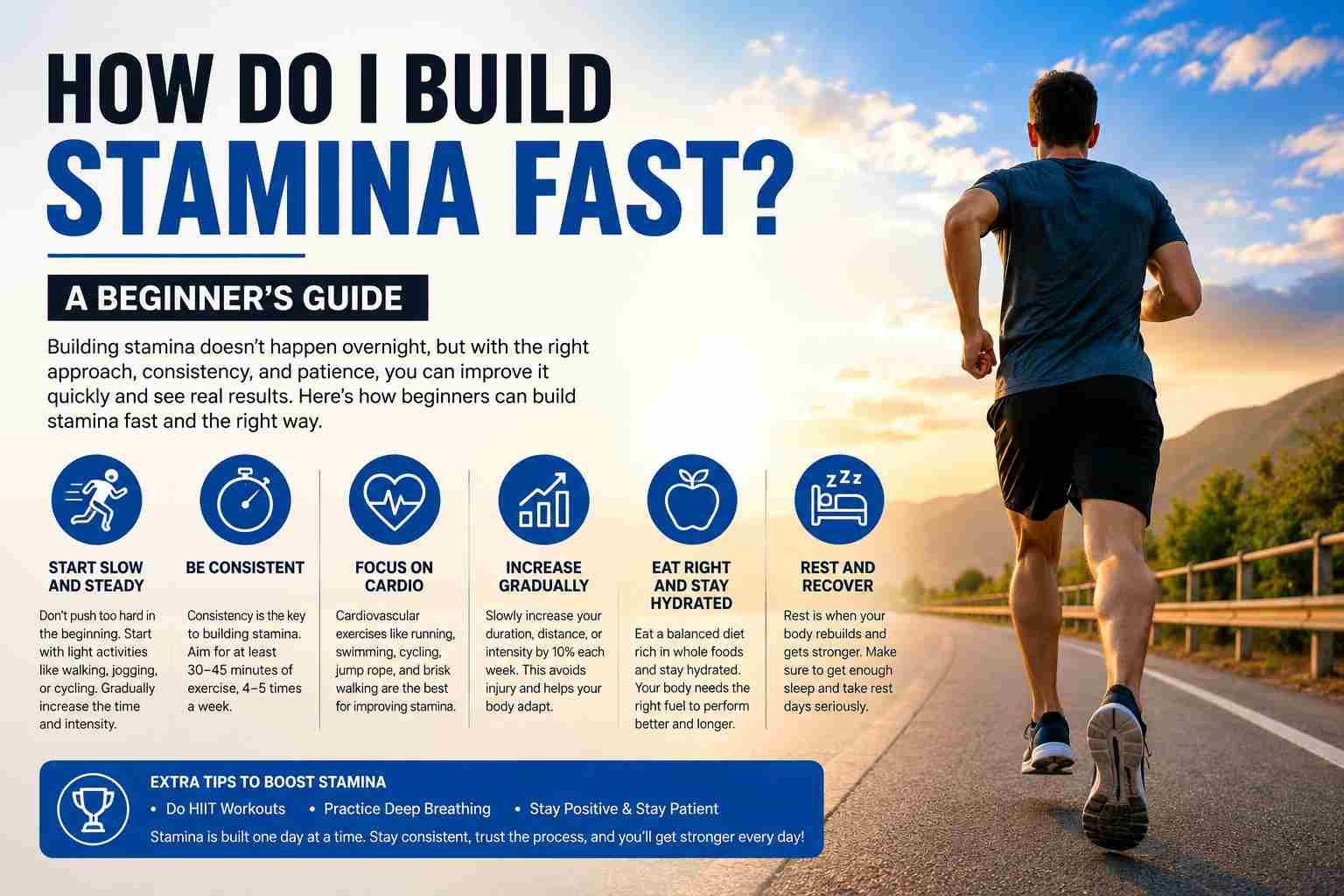
Do you get out of breath climbing a flight of stairs? Do you feel tired after just 10 minutes of jogging? You are not alone. Millions of people want to build stamina fast and the good news is, your body is designed to adapt quickly. With the right approach, you can feel a real difference in as little as 2 to 4 weeks.
This guide breaks everything down in simple steps. No gym jargon. No complicated plans. Just clear, science backed advice that works for real beginners.
| ✅ Key Takeaways What You Will Learn What stamina really means and why it matters for your daily lifeThe 7 best exercises to build endurance as a beginnerHow nutrition and sleep directly affect your stamina levelsA simple 4-week training plan you can start todayCommon beginner mistakes and how to avoid them |
1. What Is Stamina and Why Does It Matter?
Stamina is your body’s ability to keep going during physical or mental effort. When people say they want to how to increase stamina, they usually mean one of two things: cardiovascular stamina (heart and lungs) or muscular endurance (muscles). Both matter. And both improve with consistent training.
Good stamina means you can:
- Walk or run longer without stopping
- Climb stairs without getting out of breath
- Play with your kids or pets without tiring quickly
- Handle a full day of work without feeling drained
- Recover faster after exercise or illness
| 💡 What the Science Says A 2019 study published in the British Journal of Sports Medicine found that even light cardio training 3 times per week for 4 weeks showed measurable improvements in VO2 max the gold standard measure of cardiovascular fitness. |
2. How Long Does It Take to Build Stamina?
This is the question everyone wants answered. The honest answer: it depends on your starting point. But here is a general timeline most beginners can expect:
| Timeframe | What Changes | What You Will Notice |
| Week 1 to 2 | Heart rate starts adapting | Less breathlessness, slightly more energy |
| Week 3 to 4 | Lung capacity improves | Can exercise 20 to 30% longer before stopping |
| Week 5 to 8 | Muscles become more efficient | Running or walking feels noticeably easier |
| Week 9 to 12 | Full cardiovascular adaptation | Significant endurance gains, faster recovery |
| ✅ Good News for Beginners Beginners actually see the fastest improvements. If you are starting from zero fitness, your body responds to training very quickly. The first 4 weeks are when you will feel the biggest change. |
3. The 7 Best Exercises to Build Stamina Fast
For stamina for beginners the best exercises are simple, low-impact, and easy to do anywhere. Here are the 7 most effective ones:
Brisk Walking
Walking is the most underrated stamina builder. It is gentle on your joints free and highly effective. Start with 20 minutes daily and build up to 45 to 60 minutes over 4 weeks.
- Frequency: 5 days per week
- Pace: Fast enough that you can talk but not sing
- Goal: Work up to 10,000 steps per day
Jogging or Run-Walk Intervals
Run walk intervals are perfect for cardio endurance training. You alternate between jogging and walking to build endurance without burning out.
Beginner run walk plan:
- Run 1 minute, walk 2 minutes repeat 6 to 8 times
- Every week, add 30 seconds to your running interval
- By week 4, aim to run 10 minutes without stopping
Read our full Cardio for Beginners Guide for a detailed running plan.
Cycling (Outdoor or Stationary)
Cycling is a great low impact option that builds leg endurance and cardiovascular fitness at the same time. Even 20 minutes on a stationary bike 4 times a week produces results within 2 weeks.
Swimming
Swimming works your entire body and is especially good if you have joint pain. It builds both muscular and cardiovascular endurance. Just 30 minutes of freestyle swimming burns around 250 350 calories and dramatically improves lung capacity.
Jump Rope
Jump rope is one of the most time efficient stamina builders available. Just 10 minutes of jumping rope equals about 30 minutes of jogging in terms of cardiovascular benefit. Start with 1 minute on, 1 minute rest and build up from there.
HIIT (High Intensity Interval Training)
If you want to improve running stamina quickly, HIIT workout for beginners is one of the fastest methods. Research shows HIIT can improve cardiovascular fitness up to twice as fast as steady-state cardio.
A simple beginner HIIT circuit:
- 30 seconds jumping jacks 30 seconds rest
- 30 seconds high knees 30 seconds rest
- 30 seconds squats 30 seconds rest
- 30 seconds mountain climbers 30 seconds rest
- Repeat the circuit 3 to 4 times total
See our complete HIIT Workout Guide for Beginners for more circuits.
Stair Climbing
Stair climbing targets your legs, glutes, and cardiovascular system all at once. Find a staircase with at least 2 flights. Walk up and down for 10 to 15 minutes to start. Your heart rate will rise quickly, and your legs will thank you for it later.
4. Nutrition Tips That Boost Your Endurance
Exercise alone is not enough. What you eat directly affects your energy levels and your ability to cardio endurance training. Here are the key nutrition rules for building stamina
Eat Enough Carbohydrates
Carbohydrates are your body’s preferred fuel for endurance exercise. Do not cut carbs if you want more energy. Good sources include:
- Brown rice oats and whole grain bread
- Sweet potatoes and bananas
- Lentils beans and chickpeas
Get Enough Protein
Protein helps your muscles recover and grow stronger after training. Aim for 0.8 to 1.2 grams of protein per kilogram of body weight daily. Good sources include chicken, eggs, fish, Greek yogurt and legumes.
Stay Hydrated
Even mild dehydration (just 2% of body weight in fluids lost) can reduce endurance performance by up to 20%. Drink water throughout the day and sip during exercise.
Do Not Skip Pre Workout Nutrition
Eat a light carb rich snack 30 to 60 minutes before training. A banana, a slice of toast or a small bowl of oats work perfectly.
For a full meal plan, read our Nutrition Guide for Endurance Athletes.
| ⚠️ Common Mistake Exercising on an empty stomach might sound like a good idea for fat loss, but it kills your stamina. You will tire out faster, push less hard, and make slower progress. Always eat something before training. |
5. The Role of Sleep in Building Stamina
Sleep is where the real recovery happens. When you sleep, your body repairs muscle tissue, releases growth hormones, and restores energy stores. Without enough sleep, your endurance will suffer no matter how hard you train.
| Sleep Duration | Effect on Stamina |
| Less than 6 hours | Reduced endurance, higher injury risk, slower recovery |
| 7 to 8 hours | Optimal for muscle repair and cardiovascular recovery |
| 8 to 9 hours | Ideal for athletes and those doing intense training |
A 2021 study in Sports Medicine showed athletes who slept 8+ hours improved sprint times and reaction speed significantly compared to those sleeping under 6 hours.
Read our detailed guide on Sleep and Fitness Recovery for tips on improving your sleep quality.
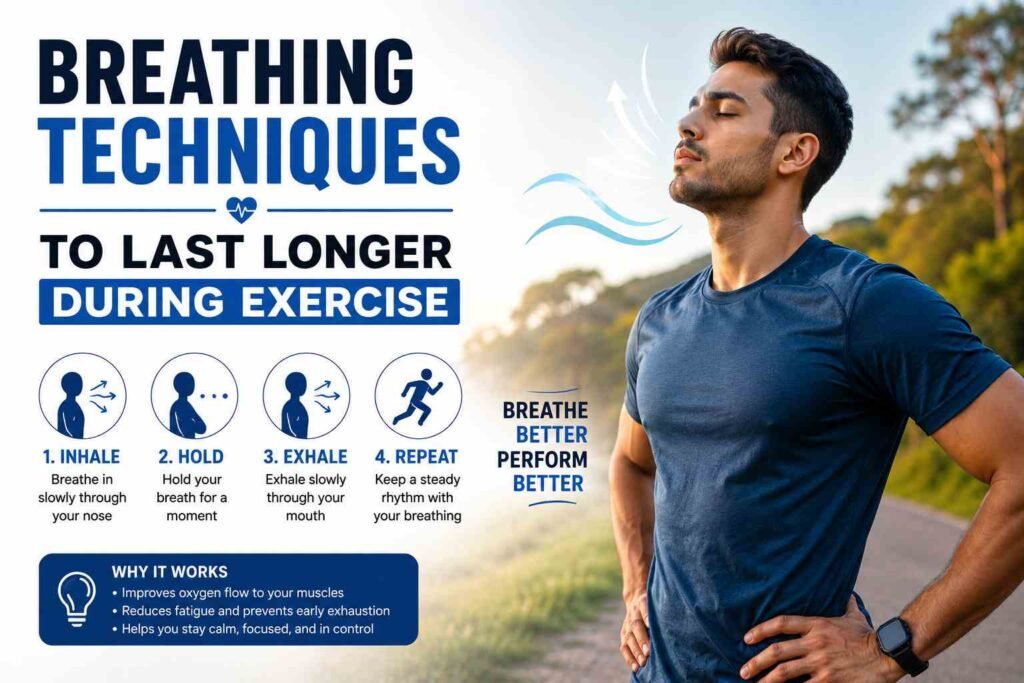
6. Breathing Techniques to Last Longer During Exercise
Most beginners waste energy by breathing wrong. Learning proper breathing exercises can immediately make you feel like you have more stamina because efficient breathing delivers more oxygen to your muscles.
Diaphragmatic (Belly) Breathing
Instead of shallow chest breathing, breathe deeply into your belly. Place one hand on your chest and one on your stomach. When you inhale, your belly should rise, not your chest. This gets more oxygen in with each breath.
The 2:2 Rhythm for Running
Inhale for 2 footsteps, exhale for 2 footsteps. This rhythmic breathing pattern helps regulate effort and prevents side stitches. As you get fitter, move to a 3:3 rhythm.
Box Breathing for Recovery
Between intervals or after a hard effort:
- Inhale for 4 counts
- Hold for 4 counts
- Exhale for 4 counts
- Hold for 4 counts
- Repeat 4 to 6 times to bring your heart rate down faster
Learn more in our Breathing Techniques for Exercise Guide.
7. Your 4 Week Beginner Stamina Training Plan
Here is a simple, structured plan for endurance exercises that you can start this week. No gym membership needed.
| Week | Monday | Wednesday | Friday | Weekend |
| Week 1 | Walk 20 min | Walk 20 min + 5 min stretch | Walk 25 min | Rest or light walk |
| Week 2 | Walk 30 min | Run/walk intervals 20 min | Cycling or swim 25 min | Rest |
| Week 3 | Run/walk 25 min | HIIT circuit 20 min | Walk/jog 30 min | Stair climb 15 min |
| Week 4 | Jog 20 min (no walk) | HIIT circuit 25 min | Jog 25 min + strength | Rest and stretch |
| ✅ Pro Tip Track your progress. Write down how long you exercised and how you felt after each session. Seeing improvement even small gains is one of the biggest motivators to keep going. |
8. Common Mistakes Beginners Make (And How to Avoid Them)
Doing Too Much Too Soon
Many beginners go too hard in the first week and end up injured or burned out. Start slower than you think you need to. Your body needs time to adapt. Increase your training volume by no more than 10% per week.
Ignoring Rest Days
Rest days are not lazy days they are recovery days. Your body actually gets stronger during rest, not during the workout. Aim for at least 2 full rest days per week.
Skipping Warm Up and Cool Down
A 5 minute warm up (light walking or dynamic stretching) prepares your muscles and heart for effort. A 5 minute cool down helps bring your heart rate down safely and reduces soreness the next day.
Not Drinking Enough Water
Even on rest days, aim for 2 to 3 litres of water. On training days add an extra 500ml to 1 litre depending on how much you sweat.
Comparing Yourself to Others
Everyone starts somewhere. What matters is that you are moving forward not how fast someone else is progressing. Focus on beating your own previous best performance.
FAQs
Q: How quickly can a beginner build stamina?
Most beginners notice a real difference within 2 to 4 weeks of consistent training. Cardiovascular improvements happen fast when you are starting from a low fitness base. Full endurance adaptation typically takes 8 to 12 weeks.
Q: Is it better to do long slow runs or short fast runs to build stamina?
Both work, but in different ways. Long, slow runs build your aerobic base and teach your body to use fat as fuel. Short, intense sessions (like HIIT) improve your VO2 max faster. For beginners, start with long slow sessions and add HIIT in week 3 or 4.
Q: Can I build stamina without running?
Absolutely. Swimming, cycling, rowing, jump rope, dancing, and even brisk walking all build excellent cardiovascular stamina. Running is just one option. Choose whatever activity you enjoy most consistency is more important than the specific exercise.
Q: Does losing weight improve stamina?
Yes, significantly. Carrying extra body weight increases the workload on your heart and lungs during exercise. Even a modest weight loss of 5 to 10% of body weight can noticeably improve endurance. But stamina training itself also helps with weight management — so they go hand in hand.
Q: How many days a week should I train to improve stamina?
For beginners, 3 to 4 days per week is ideal. This gives your body enough training stimulus to improve without risking overtraining or injury. As your fitness improves after 6 to 8 weeks, you can increase to 5 days.
Q: Is it safe to build stamina if I have a heart condition?
If you have any cardiovascular condition, high blood pressure, or have been inactive for a long time, always consult your doctor before starting a new exercise program. A medically supervised progressive plan is the safest and most effective approach.
Q: Does diet affect stamina?
Diet has a massive impact on stamina. Carbohydrates fuel your muscles during exercise, protein helps them recover, and hydration keeps every system running efficiently. Poor nutrition is one of the top reasons people struggle to improve their endurance.
About Aurthor:
Written by Sarah Mitchell Professional Medical Content Writer specializing in metabolic health diabetes and weight management. Medically reviewed by Dr. James Harper Endocrinology and Internal Medicine Specialist. All content is based on the following peer reviewed and authoritative sources.
Medical References
All sources are peer reviewed or published by recognised health authorities:
- Garber et al. (2011). Quantity and Quality of Exercise for Developing and Maintaining Cardiorespiratory, Musculoskeletal, and Neuromotor Fitness in Apparently Healthy Adults. Medicine & Science in Sports & Exercise.
- Gibala et al. (2012). Physiological adaptations to low volume, high intensity interval training in health and disease. Journal of Physiology.
- Myllymaki et al. (2011). Effects of vigorous late-night exercise on sleep quality and cardiac autonomic activity. Journal of Sleep Research.
- Sawka et al. (2007). American College of Sports Medicine Position Stand: Exercise and Fluid Replacement. Medicine & Science in Sports & Exercise.
- Fullagar et al. (2015). Sleep and Athletic Performance: The Effects of Sleep Loss on Exercise Performance. Sports Medicine.
- NHS UK (2023). Physical activity guidelines for adults. National Health Service.
- WHO (2020). WHO guidelines on physical activity and sedentary behaviour. World Health Organization.