


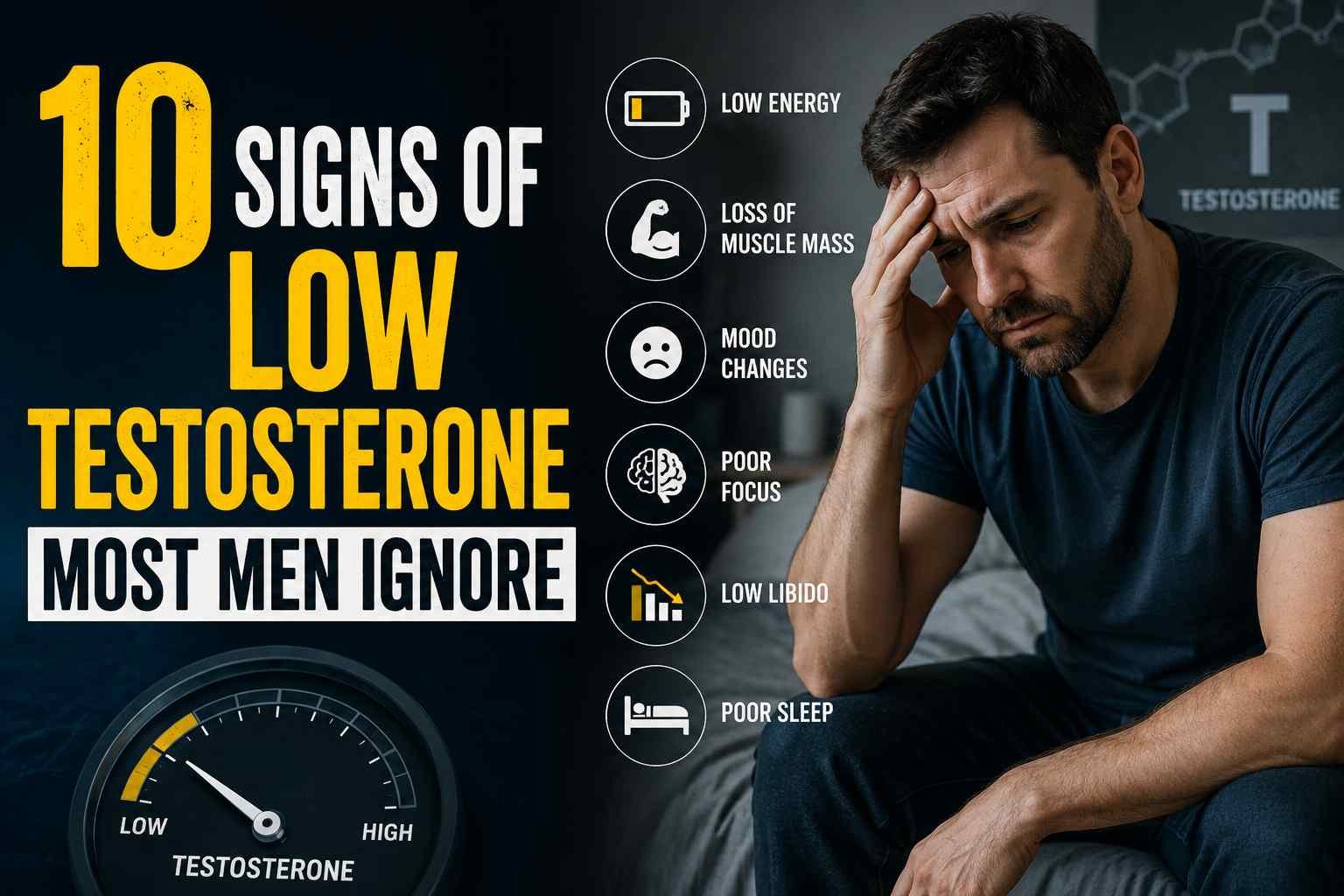
Millions of men are walking around with low testosterone and have no idea. Not because the symptoms are subtle but because they look exactly like what most men call getting older or being stressed. The truth is many of the signs of low testosterone are hiding in plain sight and ignoring them can cost you years of energy confidence and health.
This guide breaks down the 10 most commonly overlooked warning signs explains the science behind each one and tells you exactly what to do about it including natural strategies and when to seek medical advice.
Why Do Men Develop Low Testosterone?
Testosterone is produced primarily in the testes with a smaller amount from the adrenal glands. Its production is controlled by a feedback loop involving the brain’s hypothalamus and pituitary gland. When this system is disrupted by age chronic stress poor sleep excess body fat or certain medical conditions testosterone levels drop.
| Cause | How It Lowers Testosterone | Reversible? |
| Ageing after 30 | Leydig cells produce less testosterone with age | Partially |
| Chronic stress | Elevated cortisol directly suppresses testosterone synthesis | Yes |
| Poor sleep | Most testosterone is produced during deep sleep stages | Yes |
| Excess body fat | Aromatase enzyme converts testosterone to oestrogen in fat tissue | Yes |
| Sedentary lifestyle | No resistance training means less testosterone stimulus | Yes |
| Alcohol consumption | Impairs Leydig cell function and disrupts sleep quality | Yes |
| Nutritional deficiencies | Low zinc vitamin D and magnesium impair testosterone production | Yes |
10 Signs of Low Testosterone Most Men Ignore
1. Constant Fatigue That Sleep Does Not Fix
Feeling tired after a bad night is normal. Feeling exhausted every single day regardless of how many hours you sleep is a different story. Signs of low testosterone nearly always include this type of deep persistent fatigue that coffee simply cannot touch.
Testosterone plays a direct role in how efficiently your mitochondria produce cellular energy. When T is low your cells literally make less fuel. If you consistently feel drained lack motivation for things you used to enjoy and need naps just to get through the day low testosterone should be on your radar. Following
Following natural energy-boosting strategies for men can significantly help here especially fixing sleep quality since most testosterone is produced during deep sleep stages.
2. Brain Fog and Difficulty Concentrating
Testosterone receptors are found throughout the brain. When levels drop men frequently notice their thinking becomes slower their memory becomes less reliable and focusing on tasks feels like pushing through wet concrete. This is often dismissed as stress or just getting older but it is one of the clearest cognitive signs of low T.
Research published in the Journal of Clinical Endocrinology found that men with low testosterone performed significantly worse on memory and spatial reasoning tasks compared to age-matched controls with normal levels.
3. Reduced Sex Drive
This is the sign most associated with low testosterone yet many men normalise it or attribute it to relationship issues. Testosterone is the primary driver of male libido. A persistent and unexplained reduction in sexual interest is one of the clearest signs of low testosterone in men.
Low libido from low T is different from situational disinterest. It is a consistent baseline-level drop in sexual desire that affects daily life and self-image. If there is no obvious psychological or relationship cause it is worth investigating hormonally.
4. Loss of Muscle Mass and Strength
Testosterone is the primary anabolic hormone meaning it tells your body to build and preserve muscle. When levels are low muscle breakdown outpaces muscle building even if you are still training consistently. Men with low T often find they are getting weaker despite regular effort or that their muscles look softer and less defined than before.
This is closely connected to declining physical stamina. Less testosterone means less muscular endurance slower recovery and more fatigue during workouts. Many men spend months pushing harder in the gym without results simply because the hormonal environment is working against them.
5. Increased Belly Fat
Here is a cycle most men are not aware of. Low testosterone promotes fat storage particularly visceral fat around the abdomen. That fat tissue contains an enzyme called aromatase which converts testosterone into oestrogen. More belly fat means more aromatase which means less testosterone. This feedback loop can be very difficult to break without addressing the hormonal root cause.
Men who are gaining weight in the midsection despite not dramatically changing their diet should consider getting their testosterone levels checked. If weight loss treatment for men is also a concern it may be worth reading about medical weight management options available today as part of a broader metabolic health approach.
6. Persistent Low Mood or Irritability
Testosterone has a powerful effect on mood regulation. Men with clinically low T are significantly more likely to experience symptoms of depression irritability and emotional flatness. This often shows up as becoming easily frustrated feeling unmotivated or simply losing the drive and optimism that used to come naturally.
What makes this sign so easy to ignore is that men rarely connect a change in mood to their hormones. It tends to be blamed on work stress relationship problems or general burnout. All of those may be contributing factors but the hormonal dimension is frequently missed entirely.
7. Poor Sleep Quality
There is a two-way relationship between testosterone and sleep. Low T disrupts sleep quality and poor sleep further lowers testosterone. Men with low testosterone frequently report difficulty falling asleep lighter sleep overall and waking up feeling unrefreshed. Some also develop symptoms consistent with sleep apnoea which in turn drives testosterone even lower.
A landmark study found that men who slept fewer than 6 hours per night had testosterone levels equivalent to men 10 years older. Addressing sleep quality as part of natural energy restoration is therefore one of the most impactful steps any man can take for both hormone health and daily energy.
8. Reduced Bone Density
Testosterone plays a critical role in maintaining bone mineral density. Low T in men is associated with a meaningful increase in the risk of osteoporosis and stress fractures. This condition is far more commonly associated with women but is increasingly recognised as a serious concern in men as well.
Because bone loss is silent until a fracture occurs this is among the most dangerous and most ignored signs of low testosterone. Men over 40 with multiple other low T symptoms should ask their doctor about a bone density scan alongside hormone testing.
9. Declining Athletic Performance and Endurance
If your runs feel harder your gym sessions are more exhausting and your recovery takes longer than it used to low testosterone may be a significant factor. Testosterone drives red blood cell production which directly affects how much oxygen gets delivered to your muscles. Low T means less oxygen efficiency faster fatigue and reduced physical endurance.
Many men interpret declining athletic capacity as inevitable ageing when in reality the underlying hormonal environment is limiting their response to training. Learning how to build stamina fast through the right training approach alongside addressing testosterone can produce noticeably faster results.
10. Changes in Body Hair and Skin
Testosterone is responsible for the development and maintenance of male secondary sex characteristics including body and facial hair. Men with chronically low T sometimes notice their beard growth has slowed body hair is thinning or their skin is becoming drier and thinner over time.
These changes tend to be gradual and are easy to attribute to other causes. On their own they do not confirm low testosterone. But when combined with three or more other signs on this list they strengthen the case for getting tested.
How Many Signs Before You Should See a Doctor?
There is no magic number but the general clinical guidance is straightforward. If you are experiencing three or more of these signs consistently for more than four to six weeks and they are affecting your quality of life a blood test is warranted. Do not try to self-diagnose through over-the-counter testosterone boosters. A blood test measuring total and free testosterone is the only reliable way to confirm a diagnosis.
What Can You Do About Low Testosterone?
Get Tested
Ask your doctor for a morning blood test measuring total testosterone free testosterone LH FSH prolactin and SHBG. Testing in the morning matters because testosterone levels are highest between 7 and 10 AM. Normal total testosterone in adult men ranges from roughly 300 to 1000 ng/dL though symptoms can appear at different points depending on the individual.
Optimise Your Lifestyle First
For many men especially those with borderline or low-normal testosterone lifestyle changes alone can produce meaningful improvements. The key areas to focus on are:
- Fix your sleep. Seven to nine hours of quality sleep is the single most impactful natural testosterone support strategy available.
- Lift heavy weights. Compound movements like squats and deadlifts are the strongest natural stimulators of testosterone production.
- Manage stress. Chronic cortisol directly suppresses testosterone synthesis so daily stress management matters more than most men realise.
- Lose excess body fat. Reducing body fat lowers aromatase activity and slows the conversion of testosterone to oestrogen.
- Optimise nutrition. Ensure adequate zinc vitamin D magnesium and healthy fats in your daily diet.
- Cut back on alcohol. Even moderate drinking measurably lowers testosterone for up to 24 hours after consumption.
Consider Medical Options If Needed
If blood tests confirm clinically low testosterone and lifestyle changes have not produced sufficient improvement your doctor may discuss Testosterone Replacement Therapy. TRT comes in several forms including gels injections patches and pellets and can be highly effective when prescribed and monitored correctly. It is not appropriate for everyone and the decision should always be made with a qualified endocrinologist or urologist.
How Long Does It Take to See Results?
| Intervention | Expected Timeline | Realistic Outcome |
| Sleep improvement | 1 to 2 weeks | Noticeable energy and mood improvement |
| Strength training 3x per week | 4 to 8 weeks | Measurable T increase of 15 to 25 percent |
| Weight loss of 5 to 10 percent | 8 to 12 weeks | Reduced aromatase and T level improvement |
| Vitamin D supplementation | 8 to 12 weeks | T increase in men who were deficient |
| Stress reduction | 2 to 6 weeks | Cortisol drops and T rises gradually |
| TRT medical treatment | 2 to 4 weeks | Significant symptomatic improvement |
The Connection Between Low Testosterone and Stamina
One of the most direct downstream effects of low testosterone is a reduction in physical and cardiovascular endurance. Men with low T often find it harder to build stamina despite consistent training because the hormonal environment needed to adapt and improve is impaired.
Testosterone supports red blood cell production which determines how much oxygen your muscles receive. It also drives mitochondrial density meaning the number of energy producing units in each cell. This is why men with low T frequently describe exercise as feeling unusually hard and why post workout recovery takes far longer than it used to. A structured plan to build stamina fast works significantly better once the underlying hormonal environment is also being addressed.
Final Thoughts
The signs of low testosterone are easy to dismiss individually but they rarely appear alone. If you are consistently tired struggling with focus gaining belly fat losing muscle and feeling flat your hormones deserve attention. Start with a blood test and commit to the lifestyle foundations that genuinely support testosterone including better sleep strength training stress management and real nutrition. Your body is designed to respond. Give it the right conditions.
Frequently Asked Questions
What is a normal testosterone level for men?
Normal total testosterone in adult men is generally between 300 and 1000 ng/dL. However normal ranges vary by laboratory and symptoms matter as much as numbers. Some men feel the effects of low T at higher levels in the range particularly if free testosterone is low.
Can men in their 20s and 30s have low testosterone?
Yes. While testosterone decline accelerates after 30 low T can occur at any age due to stress obesity poor sleep alcohol use or underlying medical conditions. A 2019 analysis found increasing rates of low T diagnosis in men under 40 largely driven by lifestyle factors.
Are there natural supplements that boost testosterone?
A handful have reasonable research support specifically vitamin D in deficient men zinc ashwagandha which reduces cortisol and magnesium. However supplements only fill genuine gaps. They will not override poor sleep chronic stress or excess body fat. Fix the lifestyle foundations first then consider supplements for specific deficiencies.
Does low testosterone cause erectile dysfunction?
Low testosterone can contribute to reduced sexual desire and sometimes affects erectile function but erectile dysfunction has multiple causes including cardiovascular neurological and psychological factors. Low T alone is not the most common cause of ED and a full medical evaluation is needed to identify all contributing factors.
How is low testosterone diagnosed?
Through a blood test ideally taken in the morning between 7 and 10 AM when testosterone is at its daily peak. Your doctor will measure total testosterone and may also test free testosterone LH FSH prolactin and SHBG to understand the root cause. Two separate tests on different days are usually required before a diagnosis is confirmed.
About the Author
Sarah Mitchell is a Professional Medical Content Writer specialising in metabolic health men’s health and lifestyle medicine. Medically reviewed by Dr. James Harper Endocrinology and Internal Medicine Specialist.
Medical References
- Travison TG et al. A population-level decline in serum testosterone levels in American men. Journal of Clinical Endocrinology and Metabolism. 2007. View Source
- Leproult R and Van Cauter E. Effect of 1 week of sleep restriction on testosterone levels in young healthy men. JAMA. 2011. View Source
- Pilz S et al. Effect of vitamin D supplementation on testosterone levels in men. Hormone and Metabolic Research. 2011.View Source
- Bhasin S et al. Testosterone therapy in men with hypogonadism: an Endocrine Society clinical practice guideline. Journal of Clinical Endocrinology and Metabolism. 2018.View Source
- NHS UK. Male hypogonadism. National Health Service. View Source